Sunday, September 14, 2014

World of WarCraft: Warlords of Draenor - An Epic Scoring Quest!

Since January 2014, I've had the amazing privilege of being a part of the composition team for the upcoming World of WarCraft expansion, "Warlords of Draenor."

The rest of the composition team includes some of my favorite humans including, Jason Hayes, Sam Cardon, Clint Bajakian, Derek Duke, Neal Acree, my wife Eimear Noone, and of course our intrepid fearless leader Russell Brower.

If they are really humans, that is…  One never can tell in the World of WarCraft.

This sounds like a large team, but this doesn't even begin to touch on the countless singers, musicians, orchestrators, copyists and support staff needed to produce so much music at such a high level of production.

It's an absolute dream!

Now that the music has started to hit the internet, I can finally answer all of you who have been following my career and have asked to hear it.   With this in mind I created this playlist of my favorites that I composed for the game.  I'll add to it as more of the music hits the internet.

Thanks again to all of you who have reached out to me!

Warlords of Draenor, Craig Stuart Garfinkle Favorites


Are you a Video Game Music fan?  Join our mailing list us through the box at the very top right, and we will send you a free MP3, a bonus track from my score to "Baldur's Gate, The Dark Alliance II."

Next Up:  A playlist of the music written by Eimear.

Wednesday, September 10, 2014

My Experience with "Broadjam" - Is it worth it?

Many of my fellow musicians and students may be considering joining websites like Broadjam as they seem to offer good opportunities for composers, especially one's without access to "The Industry."  

Once on Broadjam's list, one gets regular emails with subjects such as:  "Last Chance for $15,000 Piano Licensing Opportunity."  "$30,000 Deadline for Positive and Bright Tracks!"  This sounds great!


I won't answer the question of "is it worth it," but instead I offer the empirical data of my experience with the website.


As my experiment was from 2011, I will offer the current rates for participating in any of these contests or working with Broadjam:


A "Primo Membership" currently costs $19.95 a month, or $199.95 for one year, or $299.95 for two years, or $399.95 for three years.  For this price you get:

  • $5 submissions to all Music Licensing Opportunities
  • Your own templated .com website ($60 value)
  • Direct access to industry professionals.
  • Sell mp3 downloads, and keep 100% of the profits for your first 500 sales
  • Unlimited Song Transmissions
  • 12 Free entries in monthly songwriting challenges ($60 Value)
  • Eligibility for spotlight in the Broadjam Newsletter, sent to thousands weekly.
There is also a Film/TV membership for $9.95 a month or $99.95 per year.  For this price you get:
  • $5 submissions to all Film/TV  Licensing Opportunities
  • Direct access to industry professionals
So here's my story:  

As I was teaching a film scoring class for UCLA continuing studies at the time, back in 2011 I decided to try using the website to market my music - to evaluate the website's value for composers just staring out.  

I also committed myself, for three months, to competing in any contest where my music was appropriate.  I signed up for a year membership and for the period of three months, I was making submissions about four or five times per week or more.

But my submissions, mostly at $5 a piece, were not without qualification.  There were certain contests I would not participate in.

For example, if you read the complete email for the two contest above offering $15,000 and $30,000 for the winner, these also says that the purse is "to be split with the publisher."  

I would never submit for these as my understanding is that if you win these contests, not only do you split the purse, a publisher would then take your publishing to the piece in question.  This did not feel right to me as my publishing and the ability to submit my pieces in multiple places at once is vital to my business.  Therefore, I would only submit to contests where there was no middle man between myself and the client.


After submitting a piece, what would happen then?  

When I would sign into my Broadjam account, I would be able to view a timeline of contest.   It would tell me things like, "On Thursday, June 9th 2011, the provider played 192 song(s).  Your  song, "Priceless Moments" was played.

Likewise, you could participate in a "Peer Review" process where fellow musicians could vote on your piece and how appropriate it would be for the project described.  The song would then be tagged with a peer rating.

For a neophyte composer, having a peer review would be of interest.  Knowing where you stand against professionals is good to know.

However, and there is no way to say this without sounding egotistical - but it needs to be said:  

As an Emmy nominated composer with 20+ years of experience, I would hope that my music would be favorably reviewed.  And I did indeed find this the case.  I was always in the top 5%.  Often I would see messages in the timeline saying my music was downloaded by the provider and under consideration.

But let's look at the empirical data:  

If there were, as it was in one case, 192 submissions, all things being equal, my chances of seeing the full purse for my $5 submission was 1 in 192, or a .0052% chance of winning.  

If you landed in the top 3, often Broadjam would kick in $50 to the second and third place compositions, changing the odds of seeing a return on your $5 investment to 3 out of 192, or .015625%

By comparison, the odds of winning at roulette, when betting on black, are 47.37%.

Still, a was committed to trying.  One win would more than wipe out what I was spending.

And then it happened.  After 30 or so submissions, I finally saw on my timeline:


Congratulations!

The Provider of this Opportunity has selected 1 of your songs, and will be contacting you. Please make sure your contact information is accurately filled out in your Broadjam account.
Please contact Broadjam Customer Service for this Provider's contact information if needed.
Please note: Broadjam is not a party to any contracts you sign with Opportunity Providers.
Here's a sceenshot from my timeline confirming my win:

A few days later I did indeed get an email from "The Provider."  I responded that I was thrilled they liked the piece and asked what the next step was to finalizing the license.

There were no further contacts from Broadjam nor "The Provider," and I never received my prize.  Multiple emails to "The Provider" were never answered.

Thus ended my experiment with Broadjam.  If you have had an experience with Broadjam, I invite you to share it in the comments below.

Like this post?  Check out my other music tech and educational posts!


Friday, July 25, 2014

And the Heavens exploded!

Finished an Epic piece yesterday for World of Warcraft: Warlords of Draenor. Written by EĆ­mear Noone, the piece holds absolutely nothing back.


While trying to record the final vocal, the Irish sky completely lit up with a firestorm of biblical proportions - killing the power, and threatening to kill anything electrical. After a few hours delay to let the storm pass, we finished the piece, but the electricity was still in the air. 

We hope to share the piece soon with all of you. — in Kilconnell, Ireland.


The Abby, in Kilconnell Ireland

UPDATE:  I am so excited that the piece discussed in this posting was finally released.  It's called "Malach."  It's also the theme at 8:05 in the "Warlords of Draenor" main menu.

You can find a fan posting of the piece at this YouTube page:


And yes, that is Eimear singing the lead female solo at the beginning and at 2:30.

Are you a Video Game Music fan?  Join our mailing list us through the box at the very top right, and we will send you a free MP3.  Just let us know if you'd like a track from "Baldur's Gate, The Dark Alliance II," or the bonus track from Eimear's "Hibernian" Mini EP.  Just let us know which you would like.

Sunday, July 20, 2014

"The Foundry" - From the Zone of Gorgrond, Warlords of Draenor Preview

It is such a pleasure to share the first of EĆ­mear Noone's compositions to be released from "Warlords of Draenor."  It's a piece from the zone of Gorgrond, entitled, "The Foundry."  

For those of you who might be keeping track, for the past nine years Eimear has been my partner in everything, our finest collaboration being our son Eliam, born last September.

But both of us being a part of the composition team for "Warlords of Draenor"is also something to be celebrated.   The Blizzard collaboration of writers, artists, directors, composers, sound designers…  a bottomless list of exceptional talent; what a joy it has been to be able to work together at such a fantastic level of creativity.

This project also marks the first time Eimear has lent her own formidable composition talents into the "World of Warcraft" franchise.  Again, for those in the know, Eimear has been a part of the team as a conductor and orchestrater since the first game - which makes this all the more special.


A big thanks to the entire Blizzard team for bringing us along for the ride, and a special thanks to our leader in all things, the exceptional Russell Brower for giving us this opportunity to shine.

Are you a Video Game Music fan?  Join our mailing list us through the box at the very top right, and we will send you a free MP3.  Just let us know if you'd like a track from "Baldur's Gate, The Dark Alliance II," or the bonus track from Eimear's "Hibernian" Mini EP.  Just let us know which you would like.

Monday, June 30, 2014

"Ghost the Musical," Comes to Los Angeles - Now Touring the Country

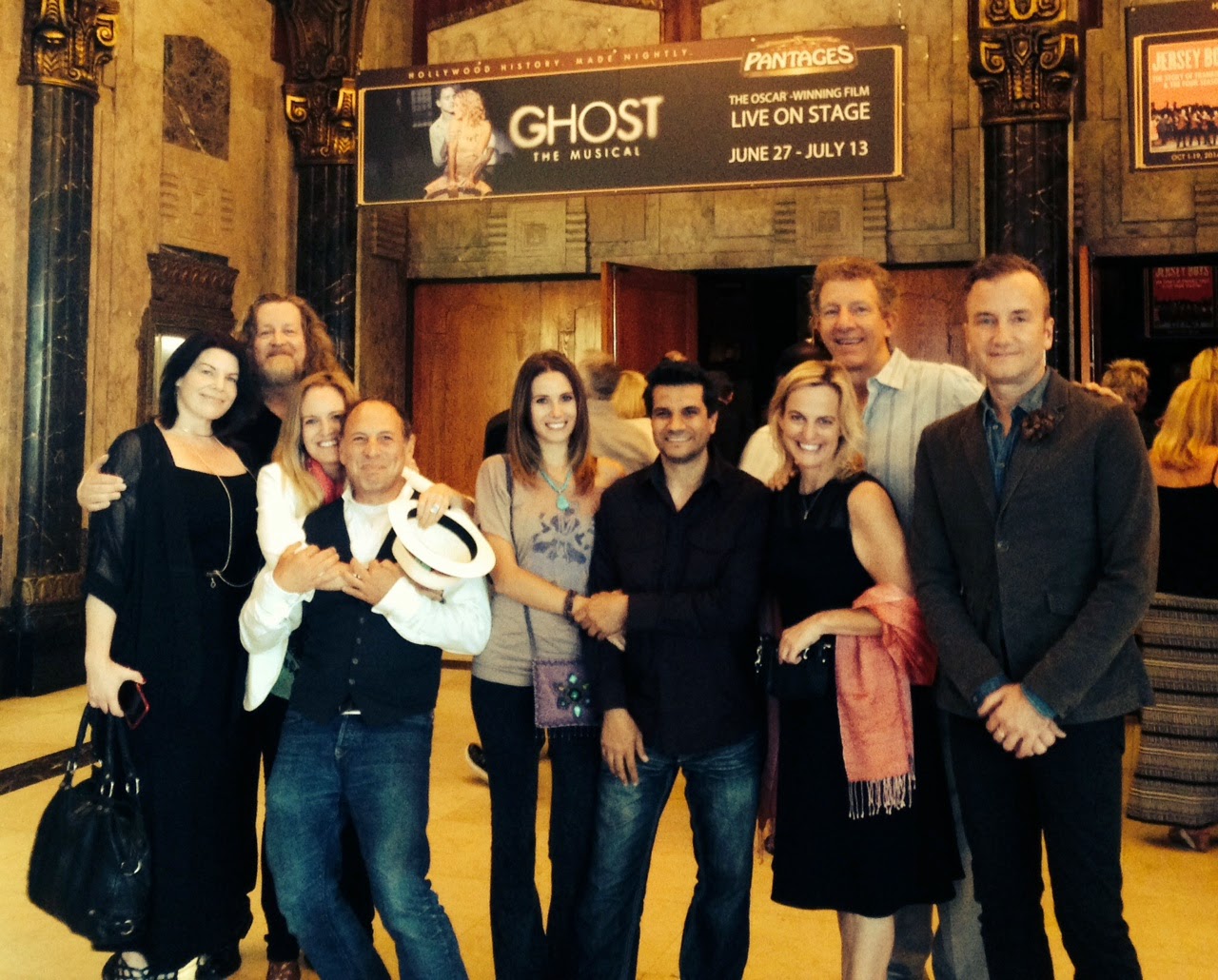
Eimear and I, and some dear friends, at the opening of my brother's show, "Ghost, the Musical" at the Pantages. It's a beautiful show, written by the insightful Bruce Joel Rubin (who also wrote the screenplay to the movie).  We had the pleasure of dining with he and his wife Blanch before the performance.
Only took my brother David Garfinkle half a decade or so to get the show to the stage!


At dinner, Bruce told the story of how when he was first approached by David, he was not sure how, or even if, "Ghost" should be adapted for the stage as a musical.  

Bruce then generously told the tale of how David came to his house and proceeded to go through the movie scene by scene, explaining how and where each song would go.  Lost in conversation, the time got late, and David missed the last train back to New York.

There was an argument at dinner as to whether missing the train was an artful ploy to continue the conversation, or an innocent over-site, but now missing the train has become Broadway legend - so I'll let you all decide the truth.

Just like Sam in the story, I picture David singing "1000 Bottles of Beer on the Wall" all night until Bruce simply gave in.

The show is in Los Angeles for the next few weeks, but is touring the country.  Catch it when it's in your town.


Friday, June 20, 2014

The Society of Composers and Lyricists host Sean Callery and Daniel Licht

I had a wonderful time moderating an evening with The Society of Composer and Lyricists, celbrating composers Sean Callery and Daniel Licht.  Here are some pictures from the event.

A big thank you to Laura Dunn and Jana Davidoff of CW3PR for their help.

SCL Director Laura Dunn Introduces the Night

Sean Callery discusses his career 

Sean Callery performing a live scoring demonstration to a cue from "Homeland"


Daniel Licht Discusses His Career


Daniel Licht in a live scoring demonstration from "Dexter"

A Special Live Performance - Bowed Glockenspiel 


Thanks for coming!

Producing "Layered Tracks" Using Gain Matching.

Have you experienced this problem when producing your layered vocal (string, brass, etc.) tracks?

You know you are going to layer back-ground vocals, three parts, two deep on a part, using only one singer.  A total of twelve tracks.

As an example, here's a screenshot of a session based on my "Stevie TV" song, "Sexy Mistake."  The scratch (muted) vocal is at the top.  The next twelve tracks are the proposed back-ground parts.  The bottom tracks are sub mixes of the instrumental tracks for recording.


If you record the multiple vocal tracks as you would a solo vocal, and use a normal routing, when you balance the first back-ground vocal against the track, it sounds balanced; but as you add the additional vocals, unless you remix the vocals after you record each part, the back-ground vocals get too loud relative to everything else.  By the time there are twelve vocals, the singer (and you) can't hear what they are singing; nor the track.  They can't match or blend the vocals and the intonation goes to hell.

Likewise, if you record the first back-ground vocal where they might actually sit in the mix when all twelve vocals are layered, the first parts are too soft and you can't really judge the performance as you record them.

There is a simple solution to this problem that with just a bit of preplanning, works perfectly to keep everything in balance throughout the recording process without having to remix the vocals after every pass.

I don't know what the technical term might be, but I call it "gain matching."  It works as follows:
  • You start by creating in the DAW, the number of vocal tracks you will have when all layers are present; in this case, twelve tracks, as was done above.
  • Next, you set the input of all twelve tracks to be the same source: your single microphone.  An easy way to do this is to highlight each track name, then select the input while holding down both the "option" and "shift" keys.

  • Then, you set the outputs of all the tracks to a single aux track.  The aux track will control the volume of all the combined vocals relative to the other elements.  This makes the overall volume of the back-ground vocals easier to control.
  • Next, you put all twelve tracks into record mode (again, use the "shift-option" key command while record enabling the highlighted tracks as a shortcut). 

  • At this point, all twelve tracks will be passing sound from the single microphone to the aux tracks (labeled BG Vocals above), summing their combined volume together.  The energy of this summed audio will be matched to what the twelve unique tracks will create when all the unique vocals have been recorded.  You then set the level of the aux track where it sounds best to you, routing the mix to the singer as well from a send off the back-ground vocal aux track. 
  • After you record the first vocal, you take half the tracks out of record mode for the second pass.  Now you will be hearing the first part (six tracks), balanced with the second part (six tracks), and the net volume of the combined tracks will be the same volume as you heard before.
  • Then, as they say on the shampoo bottle, "Lather Rinse Repeat."
If hard disk space is an issue, and you don't want to physically record all the vocals as you go, you can use "input mode" for the vocal tracks instead of record mode - leaving only the actual track you want to record in record mode. 

I prefer not to do this as I have plenty of disk space and it requires a few more key clicks along the way to keep everything balanced and a slightly more complicated routing (for another blog).

Like this post?  Check out my other music tech posts!